I Asked AI to Help Plan My Spare Room Layout: Here's What Actually Worked
AI chat tools are good at some parts of layout planning and useless at others. Here's what happened when I handed mine a tape measure's worth of real constraints and asked it to design an OO gauge layout for the spare room.

The first answer it gave me was wrong, and wrong with total confidence. I’d described the spare room, the era I model, and the stock I already own, then asked it to suggest a track plan. It came back with a tidy oval and a goods yard, and told me a first radius curve at “around 14 inches” would comfortably take my locos. It would not. Not the ones I run.
That is the honest starting point for any of this. The tools are useful, genuinely so in places, but they will hand you a confident answer that falls apart the moment a tape measure gets involved. After a few weeks of feeding ChatGPT and Claude the actual constraints of a small OO gauge layout, I’ve got a reasonably clear picture of where they help and where they’ll quietly lead you into relaying track you should never have put down.
This is what came out of it.
Where it earned its place
The single most useful thing the AI did had nothing to do with track. It was the operating sequence.
I model the LMS in the 1948 to 1952 transition era, so a small goods yard with some shunting is the natural fit for the space. I described the yard I had in mind, three sidings, a run-round loop, a kickback to a coal staithe, and asked it to write me an operating session. What does a shift actually look like? What order do the moves happen in?
It was good at this. Properly good. It gave me a sequence that started with an arrival from the fiddle yard, broke the train down, sorted wagons to the right sidings by destination, ran the loco round, and reassembled an outbound train. It flagged that the kickback siding could only be worked by propelling, which is exactly the kind of thing that makes a small layout interesting to operate rather than just watch.
When I asked it what the layout I’d described actually was, it told me I’d more or less reinvented the Inglenook. Which I had. If you don’t know the design, the OO gauge Inglenook is the canonical small shunting puzzle, and the AI naming it for me saved a fair bit of reading. It pointed me straight at the established design rather than letting me slowly rediscover it siding by siding.
It was also sharp on stock shortlisting. I asked for tank engines appropriate to a small LMS goods yard in that period and it put the Fowler 3F “Jinty” 0-6-0T at the top, which is the right answer. Over 400 of them were built, they worked yards and trip goods all over the LMS, and Bachmann’s OO model is the obvious one to buy. The Bachmann Fowler 3F Jinty runs around £115 and has an 18-pin DCC socket, so it drops a decoder in without surgery. My uncle’s the authority on livery in our group, and his note was that for the 1948 to 1952 window you want the early BR emblem rather than the late crest, which the AI didn’t distinguish between when it first suggested it.
Sequencing a shunting puzzle is where the AI was genuinely useful. Track geometry is where it fell apart.
Where it was confidently wrong
The radius problem from the opening was not a one-off. It’s the thing the AI got wrong most consistently, and it’s the one that costs you money if you believe it.
OO gauge runs on 16.5mm track and the curves need more room than people new to the hobby expect. Peco Setrack comes in three radii: first at 371mm (about 14⅝in), second at 438mm (17¼in), and third at 505mm (about 20in). The AI repeatedly told me first radius was fine for general running. It isn’t. Most ready-to-run locos with a longer wheelbase, anything with a six-coupled chassis or a bogie, will bind or derail on it. Second radius (438mm / 17¼in) is the practical floor for a layout you actually want to run, and I’ve covered why in more detail in the small layout planning questions piece.
The AI knew the radius figures when I asked it to state them directly. It just didn’t apply them. Ask it for the dimensions of Peco Setrack and it recites them correctly. Ask it to design a layout and it forgets its own numbers and gives you a curve that won’t work. That gap, knowing a fact but not using it, showed up again and again.
Era was the other weak spot. Left to its own devices it cheerfully mixed in stock that was years out of period, a diesel shunter here, a livery there that didn’t exist yet in 1950. It has no real sense of when a thing was right. It knows the Jinty existed and it knows BR existed, but it won’t tell you unprompted that a particular running number or emblem is wrong for your window. You have to already know enough to catch it, which rather defeats the point if you’re a beginner leaning on it for exactly that.
It also wildly overestimated what fits. Told it I had a shelf about 9 inches deep to work with and it kept trying to give me continuous loops that need second radius curves, which want closer to two feet. The honest answer for a shelf that shallow is shunting only, and I’ve laid out the real depths a shelf layout needs separately. The AI wanted to please me more than it wanted to tell me my idea wouldn’t fit.
The one thing it could not do
For all the back and forth, the AI never once produced a track plan I could build.
It would describe one in words. “A run-round loop along the back, three sidings fanning off a point on the left.” Fine as a concept. But ask for the actual geometry, which Setrack pieces, how many, in what order, and whether the whole thing closes up inside 4ft by 1ft, and it falls apart completely. It cannot do the spatial maths. It will tell you a plan fits when it doesn’t, because it has no model of the physical space. It’s stringing together plausible sentences about track, not solving a geometry problem.
This is the hard limit, and it’s worth being clear about. A track plan has to close. The curves have to meet. The points have to sit where there’s room for the wagon to clear the fouling point. None of that is language, and the language tools can’t do it. When I needed an actual buildable plan I went back to AnyRail, which costs about £49 as a one-time purchase and snaps real Setrack geometry together so you can see immediately whether a plan closes up. The AI is no substitute for that. Not yet, and not close.
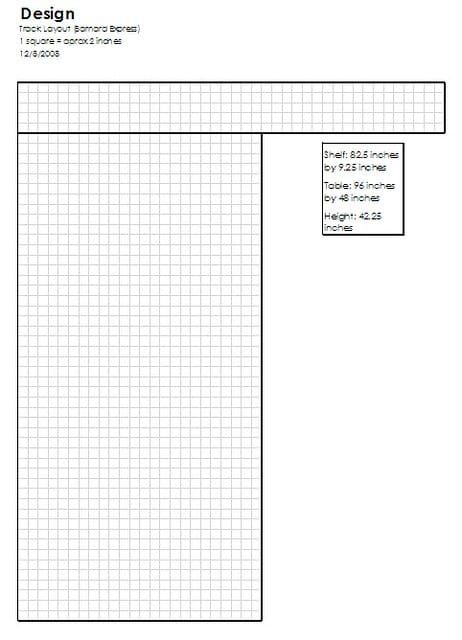
The AI could describe a track plan in words but never produce a buildable one. For real geometry, you still need planning software and a tape measure.
The prompts that actually worked
Most of the value came from treating the AI as a sounding board rather than a designer. A few approaches were worth more than the rest.
Giving it hard constraints up front helped enormously. Not “design me a small layout” but “I have a baseboard 4ft by 1ft, OO gauge, second radius minimum, LMS 1950, and I want a shunting layout. What’s a sensible track arrangement and how would I operate it?” The more real numbers you put in, the less room it has to invent something that won’t work.
Asking it to critique rather than create was the other one. I’d draw a rough plan myself, describe it, and ask what was wrong with it. It’s noticeably better at finding the flaw in something concrete than at generating something from nothing. It spotted that one of my sidings was too short to hold the wagons I’d want on it, which was a fair catch.
And asking it to explain operating prototype practice was consistently good. How was a small goods yard actually worked? What’s the difference between a trip working and a pick-up goods? That sort of background, the stuff my uncle usually fills in, it handles well because it’s reading rather than reasoning about space.
Where this goes
I came at this because the longer-term thing I’m interested in is automation, hands-off running, block detection, signalling that responds to where the trains actually are. The planning experiment was partly a way of seeing how far the current tools have come. The answer is that they’ve come further on the talking-about-it side than the doing-it side, and the gap between the two is wider than the hype suggests.
What I’d want next isn’t a chatbot that describes a track plan. It’s something that holds a real model of the space and the track library, the way AnyRail does, but that I can talk to. “Make that siding one wagon longer and tell me what it costs me elsewhere.” We’re not there. The geometry engines don’t talk and the talking tools can’t do geometry. Whoever joins those two up first will have built something genuinely useful for this hobby.
For now the split is simple enough. Use the AI for sequences, stock shortlists, prototype background, and a second opinion on a plan you’ve already drawn. Keep it well away from anything involving a curve radius or a dimension you intend to act on