Best Budget DCC Starter Systems in 2026 (Under £150 / $200)
Every DCC guide calls itself the budget option. Here's a fixed line, £150 in the UK and $200 in the US, and which systems actually stay on the right side of it.

Every DCC buying guide calls itself the budget option. Ask what “budget” means and the answer moves: £150 to one reviewer, £300 to another, and by the time you’ve read three roundups the word “beginner-friendly” has drifted a long way from your actual wallet.
So here’s a fixed line. £150 in the UK, $200 in the US. Everything below draws that line and stays on the right side of it, including telling you plainly when a name recommended everywhere doesn’t actually fit inside it.
What a genuinely sub-£150 system gets you
Two amps or less, one operator, a handheld unit that’s both the command station and the throttle in the same box. No touchscreen, no built-in wireless walkaround, no multi-protocol support for Continental stock you don’t own. For a first layout, in a spare room or on a shelf, none of that is a loss.
My own start in DCC was on a system that cost less than the decoders I’ve since fitted to half the fleet. Four locomotives running independently on a 2.4m x 1.2m board was more than the analogue controller it replaced had ever managed, and the ceiling didn’t matter because I hadn’t got near it yet.
What you do give up at this price is headroom for later. A one-amp or two-amp system runs three or four sound-fitted locomotives comfortably and starts to strain past that. If you already know you’re building something bigger than a spare-room layout, read this guide anyway, because the decoder advice at the end still applies, but budget mentally for a step up once the track plan grows past a single board.
Hornby Select (R8213): the UK system that actually fits
At £147.75 RRP, the Hornby Select is the only command station from a major name that lands inside this budget in the UK without a discount doing the work. It’s a handheld controller with an LCD readout, a rotary speed dial, and 1 amp of track power, enough for three or four OO locos running together, which covers most first layouts comfortably.
It stores up to 59 loco addresses and runs ten at once, and it handles 38 accessory decoders for points and signals through the R8247 or R8216 add-ons. For a spare-room oval with a couple of sidings, that’s headroom you won’t use for years.
Setup is genuinely a plug-and-run job. Wire the track bus, connect the transformer, and the Select is asking for a loco address inside two minutes. No software to install, no computer needed, which matters if the whole point of going digital is running trains rather than configuring a system.
The catch is the one amp. Add two or three sound-fitted locomotives and you’ll draw current faster than the spec sheet suggests, and there’s no built-in expansion path the way NCE or Digitrax offer beyond the Select Walkabout second handset. Outgrow the Select and the next step is a different command station entirely, not an add-on to this one.
Digitrax Zephyr Express (DCS52): the US pick that fits
In the States, the Digitrax Zephyr Express sits at a similar price point, typically somewhere between $150 and $180 depending on the retailer and whether it’s on offer. Worth checking the figure before you buy, because Digitrax pricing moves around more than Hornby’s does.
Three amps of track power beats the Select comfortably, and it comes with the advantage that matters most in North America: Digitrax has the largest installed base at US clubs, so if you hit a setup problem, someone nearby has almost certainly already solved it. The command station, booster and throttle are one unit, the same all-in-one shape as the Select and the pricier NCE PowerCab.
The trade-off is the interface. Digitrax’s button layout takes longer to learn than the Select’s rotary dial or NCE’s guided menu, and CV programming leans on remembering register numbers rather than being walked through it on screen. Give it an evening rather than ten minutes.
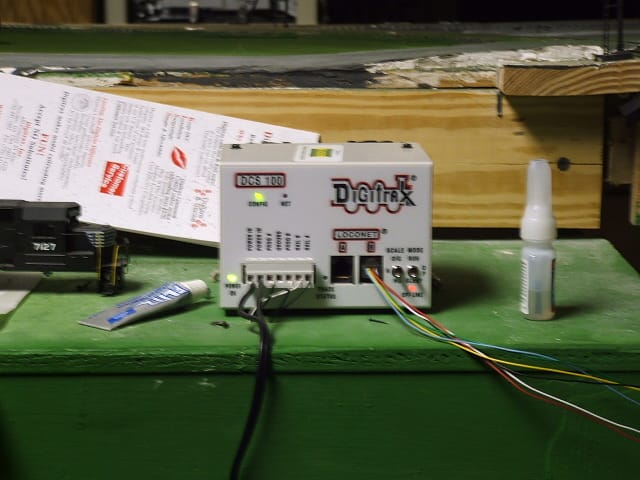
A Digitrax system running on a real layout. This is what the DCS52 is scaled down from, the same command-and-throttle logic in a starter-sized box.
Programming without paying for it
Both systems connect to JMRI, the free, open-source DCC software that runs on Windows, Mac and Linux. That matters more at this price point than it does further up the range, because it’s how you get the CV-by-CV control that pricier command stations build into their own menus.
The Select needs a third-party USB lead to talk to JMRI; the Zephyr Express takes one directly through its built-in port. Either way, DecoderPro (JMRI’s decoder tool) reads and writes every CV a NEM-standard decoder supports, for free, on hardware that’s otherwise fairly basic. It’s the thing that makes the one-amp ceiling on the Select easier to live with: the box is simple, but nothing about CV programming is limited because of it.
The genuinely cheapest way into digital control
If even a sub-£150 command station feels like a lot to spend before you’ve decided DCC is for you, there’s a cheaper first step. Fit a single loco with a Hornby TTS sound decoder at around £19 to £30 depending on the class, and you get proper DCC sound and control on that one locomotive the moment you add any command station, including the Select above.
It doesn’t skip the need for a command station entirely. TTS decoders won’t play sound on plain DC, motor control only. What it does mean is you can spend on the loco decoder first, run it under DC for now with sound switched off, and commit to the £150 controller once you actually know you’re staying with the hobby rather than testing the water.
For the socket types and wiring, our guide to fitting your first decoder covers that ground properly.
Where the well-known “budget” names actually land
This is the part most roundups skip, and it’s the part that matters if you’re actually working to a number.
The NCE PowerCab, recommended everywhere as the default beginner system, currently runs £195 to £225 in the UK and $249.95 in the US. It’s a genuinely good system, and I’ve run it on a twelve-loco roster without complaint, but it clears both budget lines here by a wide margin. If your ceiling can stretch that far, our full NCE PowerCab vs ESU ECoS vs Zimo MX10 comparison covers it properly.
Gaugemaster’s Prodigy Express, the system UK shop staff reach for first because it’s the one they know, is £267 to £310 depending on retailer. That’s Gaugemaster’s cheapest standalone DCC command station, not its most expensive. There isn’t a Gaugemaster system under £150. The brand’s budget reputation comes from decades as the analogue controller everyone grew up with, not from its current DCC range.
Bachmann’s E-Z Command looks like the simple option on paper, but the standalone controller (44932) sits around $205 to $219, and the “Plus” version usually pushed at beginners is $290. Neither fits here either.
None of that makes those systems bad. It makes the “beginner” and “budget” labels attached to them loose enough to mislead you if you’re actually holding to a number.
Head to head
| System | Price | Track power | Region fit | Expandable |
|---|---|---|---|---|
| Hornby Select (R8213) | £147.75 RRP | 1A | UK | Limited |
| Digitrax Zephyr Express (DCS52) | approx $150–180 | 3A | US | Strong, full range of boosters and throttles |
| NCE PowerCab | £195–225 / $249.95 | 2A | UK & US | Strong, but over budget |
| Gaugemaster Prodigy Express | £267–310 | 1.6A | UK | Moderate, but over budget |
| Bachmann E-Z Command | $205–290 | 1A | US | Limited, and over budget |
A note for Australian readers
Neither the Select nor the Zephyr Express is stocked new by the Australian dealers I’d usually point people towards, and Gaugemaster’s UK-plug gear needs a transformer swap to run safely on 230V AU wiring in any case. NCE is the system with the widest Australian dealer support despite sitting above this budget line, so an AU reader working to a tight number is often better served hunting a secondhand PowerCab through a local club than importing a new Select from the UK and dealing with the plug.
Points and accessories on the same budget
A command station is only half the spend. Points need accessory decoders too if you want to switch them from the same handset rather than a separate analogue switch panel, and it’s easy to blow the whole budget on the controller and forget this part entirely.
The Select’s own R8247 accessory decoder handles four points and runs comfortably within the same 1 amp system. Digitrax’s DS64 does the equivalent job on the Zephyr Express side, four outputs per decoder, and both are cheap enough, £20 to £35 each, that a two- or three-point spare-room layout adds maybe £40 to £60 on top of the command station rather than doubling the spend.
Spend what you save on decoders, not on the box
Here’s the trade worth making. A command station is a one-off purchase you’ll live with for years regardless of which side of £150 it sits on. Decoders are per loco, and a fleet of six or eight locomotives costs more in decoders than the command station did either way.
Buy the Select or the Zephyr Express, put the £50 to £150 saved against the NCE or Gaugemaster price into a couple of decent sound decoders instead, and you’ll notice the difference in what’s running on the layout far sooner than you’ll notice the difference in the handset. My cousin’s whole case for the LMS 4F we’re fitting next is about the whistle, not the controller it happens to be plugged into, and on that particular argument he’s not wrong.