Can You Control a Model Train From Your Phone? Hornby's HM7000, Explained
You can drive a locomotive from your phone now, with no command station wired to the track. Here's how Hornby's HM7000 Bluetooth decoders actually work, and where the approach runs out of road.

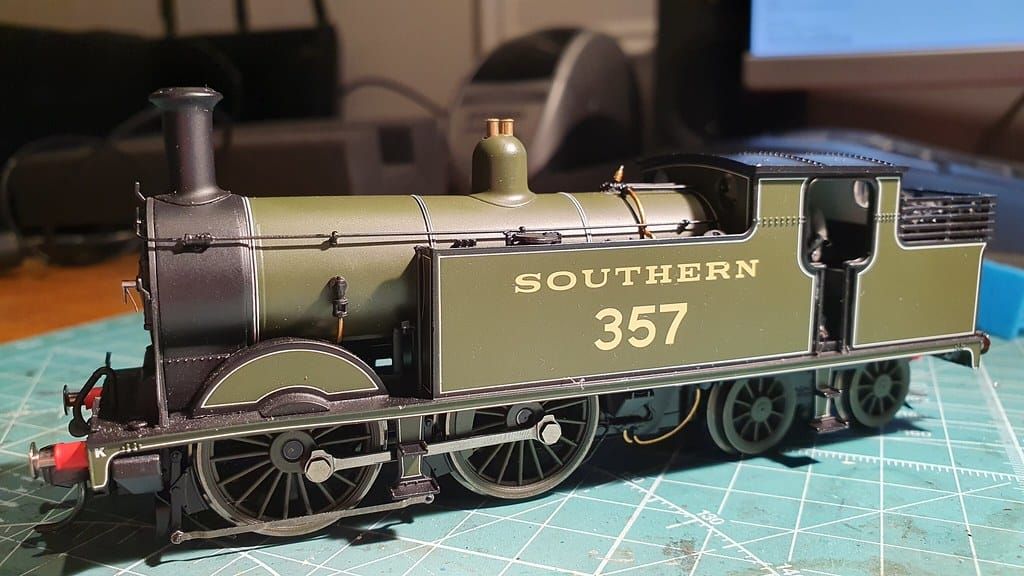
You can drive a locomotive from your phone now, with no command station, no boxed controller, and nothing wired to the track beyond power. That’s the part of Hornby’s HM7000 range worth a beginner’s attention, because it changes the sums on getting started in DCC.
The HM7000 is a decoder. It fits inside the loco the same way any decoder does, plugging into the socket or hardwired where there isn’t one. What makes it different is that as well as reading a standard DCC signal off the rails, it carries a Bluetooth radio and talks to a free app on your phone or tablet.
Two ways to run it, and one of them skips the command station
The first way is the ordinary one. Drop an HM7000 into a loco, put it on a layout running any DCC system, and it behaves as a normal decoder. It’s compatible with the kit you already own.
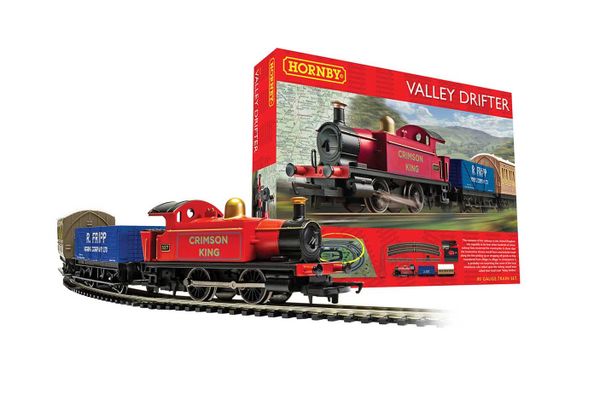
The second way is the interesting one. Put track power down, open the free HM|DCC app, and drive straight from the screen. No command station at all. For someone who hasn’t yet spent £100 or more on a system, that’s a real saving on day one: a starter oval, a power supply, one HM7000 loco, and the phone in your pocket.
The app handles the rest. You set the loco’s address from the screen, and on the sound (TXS) versions you download from a library of 30-plus sound projects and play up to three at once. Whistle, brake squeal and a station announcement layered together, all tuned with a fingertip rather than a CV table.
Which one to buy comes down to the socket
The decoder has to match the socket inside your loco, the same as any decoder fit. Get this wrong and nothing plugs in. (If you’re new to that side of it, our guide to fitting your first decoder covers the connector standards.)
Most OO locos built between roughly 2000 and 2015 use the 8-pin NEM652 socket. For those, the HM7000-8TXS sound decoder (R7336) sits around £52 to £65 depending on the day.
Newer Bachmann, Hornby and Dapol models from about 2015 onwards tend to be 21-pin, which wants the HM7000-21TXS (R7322). N gauge and small tank engines use the tiny Next18 socket and take the HM7000-N18TXS (R7345).
If you don’t want sound and just want app control, the non-sound HM7000-8 and HM7000-6 come in cheaper, around £38 to £42.
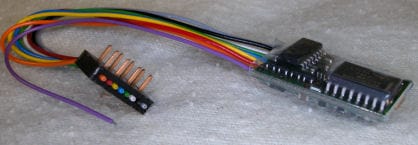
A decoder sits in the loco like any other. The HM7000 difference is that it talks Bluetooth to the app as well as reading DCC off the rails.
Where it runs out of road
Range is better than the Bluetooth label suggests, but it depends on what the loco is made of. Hornby’s own testing puts it at up to 45 metres in a plastic-bodied loco and about 12 metres in a die-cast one, because the metal body sits between the decoder aerial and your phone. For a spare room or a garage layout the plastic figure is plenty. If you mostly run heavy die-cast models, 12 metres is the number to plan around.
The bigger practical limit is driving several locos at once. Juggling two or three on a single phone screen is fiddlier than a physical controller with a knob per loco, which is the bit that rarely shows up in the launch photos.
On my own spare-room layout I run an ESU ECoS, and I’m not about to pull it out for a tablet. But for a first oval, or for putting sound into one loco without committing to a full system, the HM7000 is the cheapest honest way into digital control I’ve come across.