OO, HO, N, TT and O Scale Explained: Which Is Right for Your First Layout?
It usually starts with something innocent. A childhood memory of a train set under the Christmas tree. A visit to a friend's house where there was a layout in the garage, and you stood in the doorway longer than was probably polite. A YouTube rabbit hole at 11pm that was supposed to last five minutes and became forty-five. However you arrived here, you've ended up asking the same question every new modeller asks: which scale?
It sounds simple. It mostly is. But model railways have a remarkable talent for making straightforward decisions feel overwhelming — and scale is one of the first places that happens. Forums send you in seventeen directions at once. Manufacturer websites explain everything except what you actually need to know. And somewhere in the middle of it all, someone will tell you "it depends on your situation," which is technically accurate and completely unhelpful.
So here's the practical version, written by someone who once thought a 4.5m x 3m dedicated layout room would be more than enough space. It wasn't. It's still not. At some point in this hobby, no room is ever quite big enough — but understanding scale before you start goes a long way toward delaying that particular realisation.
Scale and Gauge: Get These Straight First
Before anything else: scale and gauge mean different things, and the hobby uses them interchangeably in ways that cause genuine confusion.
Scale is the ratio between the model and the real thing. OO scale (1:76) means the model is 76 times smaller than the prototype locomotive.
Gauge is the distance between the rails. On real railways, standard gauge is 1,435mm. Scale that down to OO and it should be about 18.83mm. In practice, OO runs on 16.5mm track — the same as HO — because when the scale was established in the 1930s, motors weren't small enough to fit in a truly accurate body. The compromise stuck. It's been mildly controversial ever since, and most OO modellers don't care at all.
The key thing to know: some scales share track, some don't. Buying track and locomotives from incompatible systems is one of the most common and avoidable beginner mistakes.
OO Scale — The Home Scale for UK and Australian Modellers
If you're in the UK or Australia, OO scale is almost certainly where you belong, and the fact that it often gets mentioned as an afterthought in beginner guides is genuinely baffling.
OO runs at 1:76.2 on 16.5mm gauge track. It is the dominant scale in the UK — Hornby, Bachmann UK, Dapol and Heljan build their core ranges around it. The second-hand market is vast. Clubs are built around it. If you want a Class 47 in Regional Railways livery, a Gresley A4, a Mk2 coach or anything from the BR blue era, OO is where the products are and where the community lives.
Space requirements are nearly identical to HO. A comfortable first layout fits on a 6x4 foot baseboard. Running curves of 2nd radius (438mm) or larger look good and run reliably; tighter than that and some longer locomotives will protest.
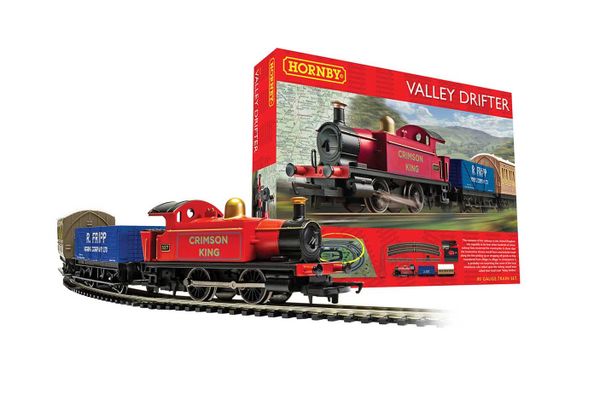
The honest truth about OO is that most beginners in the UK don't realise how good the entry-level product range is. A Bachmann or Hornby starter set in OO gives you a locomotive, coaches or wagons, a powered oval of track and a controller — all matched to work together, all at a sensible price, all with wide compatibility for future expansion.
My own first layout was OO, on a 6x4 board in what I optimistically called "the spare room." It's still OO. The room is no longer spare.
HO Scale — The Global Standard
HO (1:87) is the most popular scale in the world outside the UK, and it's earned that position honestly. The product range is simply enormous. Athearn, Bachmann, Kato, Atlas, Walthers — every major American manufacturer produces their core range in HO. European manufacturers largely do the same. If a model exists somewhere in the hobby, it probably exists in HO.
The models are satisfying to handle and detailed enough to reward close inspection, while still small enough to fit a decent layout on a 6x4 baseboard. Compatibility between manufacturers is generally good. The second-hand market is huge globally. DCC decoders, structures, scenery materials, track systems — all of it is available in abundance.
If you're modelling American, European or Japanese prototype railways, HO is almost certainly your scale. There's no good argument for starting elsewhere unless space forces you toward N.
TT Scale — The New Option Worth Knowing About
TT scale (1:120) sits between HO and N — physically smaller than HO but noticeably larger than N, running on 12mm gauge track. It's not a new concept (it existed in the 1950s and remains popular in Germany and Eastern Europe), but for UK modellers it's effectively new thanks to Hornby's TT:120 range, launched in 2022.
Hornby's pitch is straightforward: all the British prototype content you want from OO, in a footprint about 30% smaller. A layout that needs a 6x4 board in OO will fit on roughly a 4.5x3 in TT:120. For modellers who want to build something serious but are genuinely constrained by space, that's a meaningful difference.
The caveat — and it's an honest one — is that TT:120 is still a young range. The locomotive and rolling stock selection is growing but limited compared to what decades of OO production have accumulated. You won't find the same depth of second-hand stock, the same variety of manufacturers, or the same range of structures and accessories. That will change over time as the range matures, but right now you're working with what Hornby has chosen to produce.
If you're a UK modeller with restricted space and you're starting fresh today, TT:120 is genuinely worth considering. If you want the widest possible product choice, OO is still the better answer.
N Scale — Serious Layouts in Small Spaces
N scale (1:160) is small. A locomotive that's 20cm long in OO is about 13cm in N. That compounds across a whole layout: what requires a 6x4 board in OO fits on a shelf in N. Layouts have been built in briefcases, in coffee table frames, and across a single floating wall shelf.
This is the real appeal of N, and it's a genuine one. If your space is truly limited — not "I'd prefer more room" but "this is genuinely what I have" — N scale opens up layout possibilities that don't exist in larger scales. N also excels at long trains and sweeping curves; the same table that fits a modest oval in OO can accommodate an impressive mainline run with a full-length passenger consist in N.
The trade-offs are handling and maintenance. N scale components are small, couplers are fiddly, and track needs to be kept very clean. Debris that an OO locomotive would roll over will stop an N engine. If close detail work frustrates you, factor that in before committing.
Kato makes some of the best N scale track available — their Unitrack system clicks together cleanly and stays connected, which matters more in N than in larger scales.
O Scale — Large, Impressive, and Specific
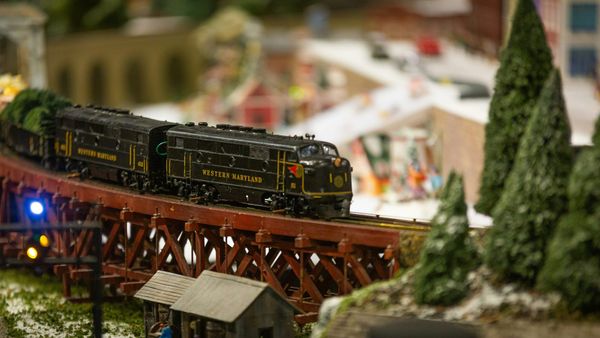
O scale (1:48) is where Lionel lives, and for many people, that's the entire point. If you grew up with a Lionel set under the tree, or you're buying for a child and want something chunky, robust and immediately satisfying, O scale makes complete sense.
The locomotives are heavy and impressive. Detail is visible from across the room. There's a particular pleasure to running O scale that smaller scales don't quite replicate.
What O scale isn't is a scale for someone building a serious scenic layout from scratch without significant space. A minimum oval needs around 6x8 feet; anything with a yard or interesting track geometry needs more. Prices per item are higher than OO or HO, and the product range outside the Lionel/MTH American ecosystem is narrower.
There's also a split between traditional 3-rail O (most Lionel) and 2-rail scale O (for realistic layout modelling). The two aren't fully compatible — worth deciding which direction you're heading before buying track.
The Decision, Plainly
OO — UK or Australia, modelling British prototype railways. This is the home scale. Start here.
HO — American, European or Japanese prototype. Widest global product range.
TT:120 — UK modeller, space is a genuine constraint, comfortable starting with a newer and growing range.
N — Space is seriously limited, or you want ambitious long-train running in a small footprint.
O — Nostalgia, children, or you're specifically drawn to the Lionel range.
Most people asking this question belong in OO or HO. Most people who don't have the space belong in N. TT:120 is an increasingly good answer for space-constrained UK modellers who want British prototype content. O scale knows exactly who it's for.
One Last Thing
Whichever scale you choose, start with a quality ready-to-run starter set rather than buying components separately. It gives you track, locomotive, rolling stock and a power supply tested to work together, with no compatibility guesswork. Building a parts list before you know what you're doing leads to headaches no beginner needs in the first month.
The danger of a good starter set, of course, is that it works. And once it works, you'll start thinking about extensions. And somewhere around the third locomotive, you'll stop thinking about trains and start thinking about the railway. That's when the hobby properly begins.