Build Your First Model Train Layout for Under $500: A Realistic HO Scale Guide
A no-nonsense breakdown of what a first HO scale layout actually costs in North America — Bachmann starter sets, Atlas track, Woodland Scenics scenery and Walthers structures, with an honest budget table and advice on where to save.

Most beginner guides to building a model train layout fall into one of two camps. The first tells you it can be done for next to nothing with a bit of ingenuity and a trip to the craft store. The second quietly assumes a budget that starts where yours ends. Neither is particularly useful.
This guide sits in the middle. It's built around a real $500 budget for a first HO scale layout — the most popular scale in North America, with the widest product range and the deepest second-hand market. It covers what you'll actually spend, where you can save, and where cutting corners will cost you more in the long run.
Plan First. Seriously.
The most common budget mistake in this hobby isn't buying something too expensive — it's buying the wrong thing and having to buy again. Before you spend a dollar on track, spend an hour on a layout plan.
SCARM is free and does everything a first-time planner needs. XtrkCAD is also free and popular with HO modelers. Atlas publishes free track plans in their "HO Layouts for Every Space" series and makes them available online — their designs are specifically calibrated for the Atlas track they're intended to be built with, which makes the component list straightforward.
A 4x8 foot layout is the standard starting point for HO scale. It's the size of a standard sheet of plywood, it fits in most spare rooms, and it's large enough to include a loop, a passing siding and a small yard. Most published beginner plans are designed around it.
The Benchwork: $50–$80
A 4x8 foot layout lives on a sheet of ¾ inch (19mm) plywood, supported by a simple L-girder or open-grid frame built from 1x4 and 1x2 lumber. Current lumber prices make this more expensive than it was a few years ago — budget $50–75 for the plywood and framing together at a Home Depot or Lowe's.
The cheapest approach that still works: a sheet of 1" thick foam insulation board (available at home improvement stores for $25–35) on top of a simple table or folding workbench. Foam is easy to carve for scenery, pins hold in it without a hammer, and it deadens sound from running trains. Many experienced modelers prefer it to plywood. The trade-off is that it's less rigid for large layouts — fine for a 4x8 first build.
The Starter Set: $90–$130
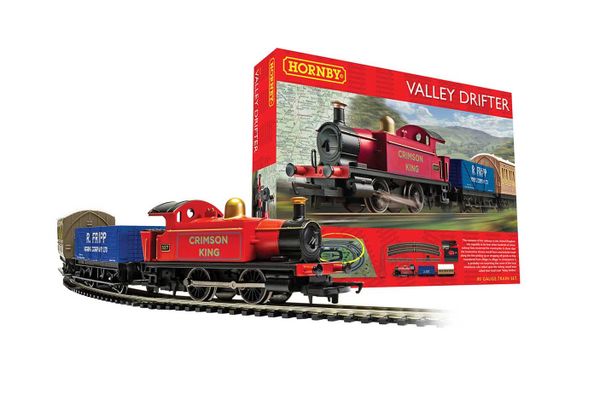
A starter set gives you a locomotive, some rolling stock, a power pack and a basic oval of track in one box. For HO scale in North America, Bachmann is the standard recommendation at this price point. Their EZ-Track system uses nickel-silver rail on a gray plastic roadbed that clips together without tools — reliable for a beginner, compatible with additional EZ-Track pieces for expansion.
The Bachmann HO EZ-Track starter sets run from around $90 to $130 depending on the specific set and retailer. Look for sets that include a diesel or steam locomotive, a few freight cars and a power pack. The locomotive's quality matters more than the rolling stock at this stage — a smooth-running locomotive on basic rolling stock is more satisfying than a rough runner in a well-detailed train.
Avoid: sets priced under $60. These typically include older mechanism locomotives that run poorly, frustrate beginners, and undermine the whole experience. The $90–130 range is where reliable running starts.
Additional Track: $40–$70
The starter set oval is a starting point, not a layout. To build even a simple loop with a passing siding you'll need additional track and at minimum one or two turnouts (switches).
Bachmann EZ-Track additional pieces are widely available and keep things simple if you started with an EZ-Track set — everything clips together with no separate roadbed to manage.
Atlas Code 100 Snap-Track is the other common beginner choice, and many modelers prefer it. The track is reliable, widely compatible, and Atlas publishes layout plans specifically designed around their Snap-Track geometry. Their Code 100 Starter Set ($35–45) includes a loop with a siding and is a good addition to a Bachmann starter set if you want a track plan to follow.
Budget $40–70 for enough additional track and two turnouts to build a simple layout beyond the basic oval.
Scenery: $60–$90
Woodland Scenics is the go-to for scenery materials in North America, available through virtually every hobby retailer and widely on Amazon. Their Scenery Kit ($60–65) includes enough material to build a small diorama and introduces the main techniques — plaster cloth for terrain forming, ground foam for ground cover, and basic trees.
For a full 4x8 baseboard, budget:
- Plaster cloth or foam for terrain shaping: $15–25
- Woodland Scenics ground foam, static grass, scatter: $30–40
- Ballast (gray or brown, depending on your railroad era): $10–15
- Brown/earth paint for base coat: $5–10
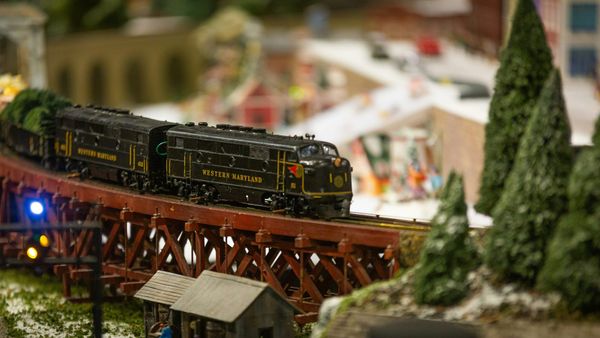
This isn't a complete scenic budget — it's enough to make your layout look like a real place rather than a test track.
Structures: $40–$60
A layout without buildings looks incomplete. Walthers, Atlas and Woodland Scenics all produce HO scale structure kits at a range of price points. For a first layout:
- One or two Walthers Cornerstone structure kits at $15–25 each are solid value — well-detailed, well-documented, and satisfying to build
- Woodland Scenics pre-built structures (from their Built-&-Ready range) cost more but go straight onto the layout without assembly
Start with two or three structures that make geographic sense together — a small depot, an industry of some kind, and a road crossing. You don't need a city. You need enough to make the scene feel inhabited.
The Honest Budget Breakdown
| Item | Budget end | Mid-range |
|---|---|---|
| Benchwork (plywood + lumber, or foam) | $55 | $75 |
| Starter set (loco + stock + power + oval) | $95 | $125 |
| Additional track + turnouts | $45 | $65 |
| Scenery materials | $60 | $85 |
| Structures | $40 | $55 |
| Paint, glue, wire, sundries | $20 | $30 |
| Total | $315 | $435 |
The budget end gets you a working, scenic layout that runs reliably. The mid-range gets you better materials and more scenery detail. You're inside $500 either way.
The gap between your total and $500 is not spare change — it's the second locomotive, the extra siding you'll decide you need, and the bag of ballast you'll run out of at the worst possible moment. Budget for it now.
New vs. Second-Hand
The HO scale second-hand market in North America is enormous. eBay, local hobby shops, train shows and the classifieds on forums like the Atlas forum and TrainBoard are full of good rolling stock and locomotives from modelers upgrading or changing direction.
Buy new: track (especially turnouts), power supplies, and anything electronic. Second-hand track is rarely straight, rarely clean, and rarely worth the savings.
Consider second-hand: locomotives (test before buying if possible, or buy from a seller with returns), rolling stock, structures and scenery materials that often come in bulk.
One More Thing
I've seen a lot of first layouts. The ones that get finished share one characteristic: they were planned before they were built. Not over-planned — just enough to know what track you need, where the buildings go, and what the finished thing is supposed to look like.
The ones that stall are usually the ones that started with a pile of components and figured the rest out later. It doesn't work that way. Draw the plan first, then spend the money.