Build Your First Model Railway Layout for Under £500: A Realistic UK Guide
A component-by-component breakdown of what a first OO gauge layout actually costs in the UK — baseboard, starter set, PECO Setrack, Woodland Scenics and structures. No surprises, no padding, just where the money goes.

There's a particular kind of optimism that strikes when you first decide to build a layout. You picture the finished thing — trains running through a proper landscape, signals working, maybe a bit of low-lying mist from a smoke unit if you're feeling ambitious. Then you start adding things up, and the number on the screen is larger than you expected.
The good news is that a genuinely satisfying first OO gauge layout — working trains, a decent baseboard, some scenery that doesn't embarrass you — is achievable for under £500 if you spend wisely. The bad news is that it's also very easy to spend £500 and end up with a pile of components that don't quite work together and a layout that's half-built and parked in a corner.
This guide is the honest version. What to buy, in what order, and where the money actually goes.
Plan Before You Spend a Penny
The single most expensive mistake in this hobby is buying track before you have a plan. You end up with too many curves, not enough straights, three left-hand points when you needed a right, and a second trip to the model shop before you've laid a single piece.
Spend an evening with SCARM (free layout planning software) or AnyRail (paid, but with a free version that handles small layouts). Draw your baseboard dimensions, experiment with track arrangements, and confirm your plan works before ordering anything. PECO's OO Setrack Planbook is also worth the £3.95 — it includes dozens of tried-and-tested plans sized for real baseboards, with component lists for each.
This costs nothing or close to nothing, and it will save you real money.
The Baseboard: £40–£60
Your layout needs something to sit on. For a first layout, a single 6x4 foot (1.8m x 1.2m) baseboard is the standard starting point — large enough to do something interesting, small enough to actually finish.
The most practical approach: a sheet of 9mm plywood from B&Q or Wickes (around £25–30), framed underneath with 2"x1" timber battens to prevent warping. Total cost for materials is typically £40–55. If you're not confident with basic woodwork, a pre-made hollow-core door blank from a builders' merchant makes a surprisingly good baseboard and costs around £30–40.
Don't use chipboard or MDF for the baseboard surface. Chipboard doesn't hold track pins well and swells with humidity. MDF is heavy and doesn't like moisture. Plywood is the right answer.
The Starter Set: £80–£120
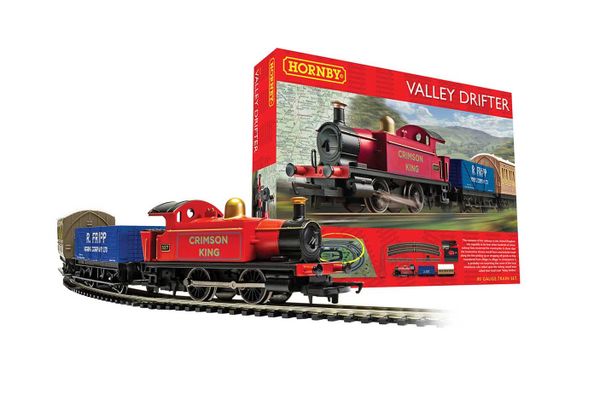
The starter set is your locomotive, some rolling stock, a basic oval of track and a controller in one box. Hornby and Bachmann both offer sets in this range, and for a first layout, starting with one makes sense — the components are matched to work together, and you don't have to worry about controller compatibility before you've run a single train.
Hornby Railroad range is the budget-conscious entry point. Railroad locomotives are less detailed than Hornby's mainline models but run reliably and are good enough for a first layout. Sets typically include a locomotive, two or three wagons or coaches, an oval of track and an analogue controller.
Bachmann offers similar value and their mechanisms are generally well-regarded by the community.
What to avoid: sets at the very bottom of the price range (under £60) often include locomotives with older mechanisms that run poorly and frustrate beginners. The £80–120 range is the sweet spot — reliable enough to enjoy, affordable enough to be a starting point rather than the whole budget.
One thing the starter set won't give you: enough track for anything beyond a basic oval. That's deliberate — it keeps the set price down and lets you add track to your actual plan.
Track: £50–£80
PECO Setrack is the standard recommendation for UK OO gauge beginners, and the community consensus on this is essentially unanimous. It's robust, compatible with Hornby and Bachmann track (all Code 100), clips together without the need for rail joiners on every piece, and is available from every model railway retailer in the UK.
For a simple first layout with a passing loop or a small siding, you'll need:
- The PECO OO Setrack Starter Set (ST-100, around £30–35) — includes a circle of 2nd radius track, straights, two turnouts, buffer stops and power clips
- A few additional straight and curved pieces to reach your baseboard edges: £15–25
If your plan includes a passing loop or headshunt, budget toward the top of this range. If you're running a simple oval with one siding, the starter set plus a small top-up will do it.
One important note on points (turnouts): PECO's Electrofrog points give better electrical continuity than Insulfrog, especially for shorter locomotives. They cost a little more but are worth it.
Scenery: £60–£90
Scenery is where a layout transforms from a track test into something you actually want to look at. You don't need to do it all at once, but budgeting for the basics at the start prevents the half-finished layout syndrome.
Woodland Scenics is the industry standard for scenic materials worldwide, and widely available through UK model railway retailers. Their Earth Colours kit and Fine Turf range give you ground cover, static grass, scatter and basic colouring at reasonable prices.
For a 6x4 baseboard, budget roughly:
- Plaster cloth or polystyrene for terrain shaping: £10–15
- Woodland Scenics ground foam, scatter and static grass: £25–35
- Paint (brown, grey, black — artist's acrylic or cheap household emulsion): £8–12
- Ballast for the track: £8–12
This isn't a comprehensive scenery budget — it's enough to make the layout look finished rather than like a test track on a sheet of plywood.
Structures: £40–£60
A layout with no buildings looks wrong. One or two structures makes an enormous difference to how finished the thing feels.
Hornby, Bachmann Scenecraft and Metcalfe all produce OO gauge buildings at varying price points. Metcalfe's card kits are the budget choice — typically £6–12 per building, look excellent when built carefully, and are genuinely satisfying to assemble. Bachmann Scenecraft pre-built structures cost more (£15–30 each) but go straight onto the layout with no building required.
For a first layout: two or three Metcalfe card kits plus one pre-built Bachmann Scenecraft building gives you a plausible scene without consuming your entire remaining budget.
The Honest Budget Breakdown
| Item | Budget end | Mid-range |
|---|---|---|
| Baseboard materials | £40 | £55 |
| Starter set (loco + stock + controller) | £85 | £110 |
| Additional track + points | £50 | £75 |
| Scenery materials | £60 | £85 |
| Structures | £40 | £55 |
| Paint, glue, wire, sundries | £20 | £30 |
| Total | £295 | £410 |
The budget end gets you a working layout you can be proud of. The mid-range gets you something with a bit more scenery detail and better-quality buildings. Either way, you're well inside £500.
What's the remaining £90–200 for? That's the contingency, the second locomotive you'll absolutely want once the first one is running, and the extra siding you'll decide you need about six weeks in. Budget for it now and you won't be surprised.
New vs. Second-Hand
The second-hand market for OO gauge in the UK is excellent. eBay, RMweb's classifieds and model railway swap meets are full of decent locomotives and rolling stock from modellers upgrading or downsizing. A locomotive that costs £90 new can often be found second-hand for £35–50 in good running order.
Where to buy new: track (second-hand track is rarely worth the faff), electronics (buy new — old controllers can be unreliable), and anything that needs to run reliably from day one.
Where to consider second-hand: additional locomotives, rolling stock, structures, and scenery materials that often come in larger quantities than needed by their original owner.
What Comes Next
I've built a few first layouts over the years, and the one thing I'd tell any beginner is this: the £500 layout isn't the layout you'll keep forever. It's the layout that teaches you what you actually want to build. The second layout is always better — because you know more, you've made the obvious mistakes, and you know exactly what you'd do differently.
That's not a reason to wait. It's a reason to start now.