Best DCC Systems for Beginners in 2026: NCE, Digitrax, Gaugemaster and Bachmann Compared
The DCC system question gets more confusing than it needs to be. Here's a plain comparison of the four systems beginners actually end up buying — what each does well, what each does badly, and which one to start with.
At some point — usually after running a single locomotive around an oval for a few months — you'll start wanting to run two trains independently. And the moment you want to do that, DC stops being the right answer.
DCC (Digital Command Control) is the modern standard for model railways. Each locomotive has a small decoder fitted inside it, assigned its own address, and controlled independently through a command station. You can run a freight train slowly through a yard while an express thunders past on the main line. You can control lights, sounds, and slow-speed behaviour per locomotive. It's genuinely transformative once you've used it.
The question beginners ask — and get very different answers to — is which system to buy first. This is that answer.
Before You Buy: What DCC Actually Requires
A DCC system has two parts: the command station (the brains, sends signals to the track) and the throttle (the handheld controller). Sometimes these are combined into one unit, which is what most beginner systems do.
Your locomotives need DCC decoders. Some locos come DCC-ready (a socket fitted, just plug in a decoder) or DCC-fitted (decoder already installed). Analogue DC locomotives won't run properly on DCC track without a decoder — they'll either sit still or run at full speed with no control.
Amps matter. A typical starter system delivers 2–3 amps, which is enough for a small layout with 3–5 locomotives. Larger layouts with more trains running simultaneously need more power — something to think about when choosing a system you might grow into.
NCE PowerCab — The Community Favourite
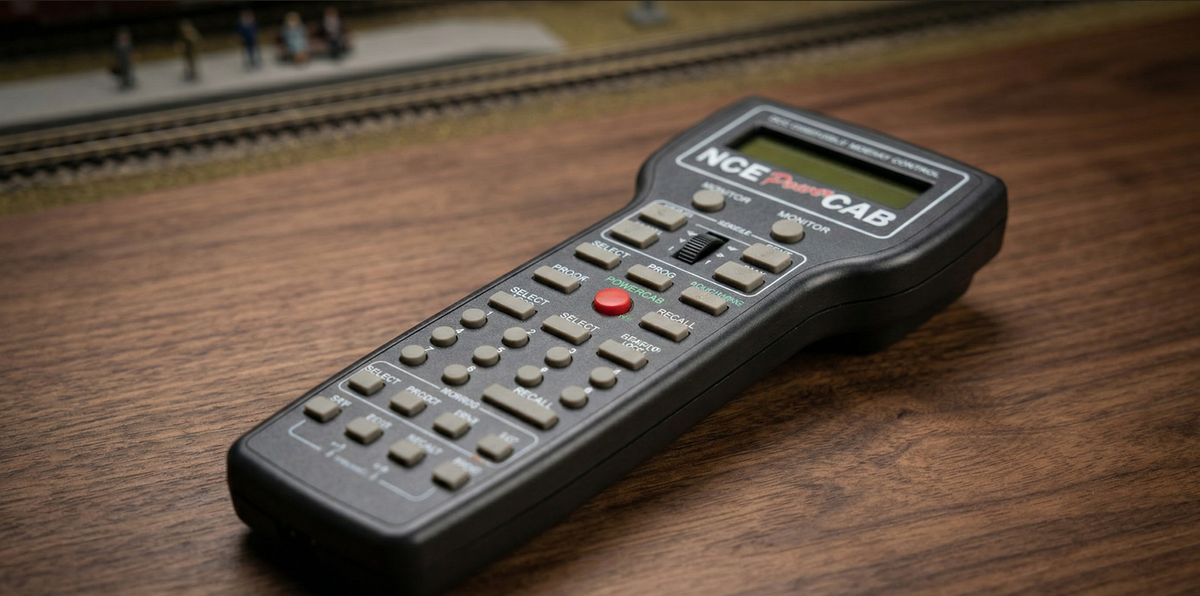
The NCE PowerCab is the system most experienced modellers recommend to beginners, and it's earned that reputation over many years. It's a combined throttle and command station in one handheld unit, delivering 2 amps of track power.
What makes it stand out is its ergonomics. The PowerCab is designed to be used single-handed — the speed knob, direction button and function keys all fall naturally under your fingers. Programming CVs (the settings that control decoder behaviour) uses a clear, logical menu rather than obscure button combinations. For someone new to DCC, that matters more than it sounds.
The system is also genuinely expandable. Start with the PowerCab alone; add a Pro Cab or USB interface later when your layout grows. NCE has a strong following in both North America and the UK, and support from the community is excellent.
Price: around $165 USD / £130–150 in the UK.
The main criticism — that it's "underpowered by modern standards" — is largely irrelevant for a first layout. 2 amps runs 3–4 locomotives comfortably. If you're eventually running a large club layout with 10 trains, you'll need something bigger. You're not there yet.
Digitrax Zephyr — The Expandable Option
Digitrax is the dominant DCC brand in North America, and the Zephyr is their beginner entry point. It delivers 2.5 amps (slightly more than the NCE) and includes one of the most comprehensive feature sets you'll find at this price — 128 speed steps, the ability to address every locomotive on your layout, and compatibility with the full Digitrax ecosystem as you expand.
The Zephyr's expandability is its strongest selling point. Digitrax's system is one of the most widely supported in North America, meaning there's an enormous range of compatible throttles, boosters, and automation modules available when you're ready for them.
The trade-off is complexity. The Zephyr's throttle is less intuitive than the NCE PowerCab — the button layout takes longer to learn, and CV programming is less straightforward for a true beginner. Many modellers find it perfectly manageable; others find the learning curve frustrating in the first few weeks.
Price: around $130–150 USD (less widely available in the UK).
If you're in North America, have friends or club members who use Digitrax, and plan to build a larger layout eventually, the Zephyr is a sensible long-term investment. If you want simplicity first, the NCE is the better starting point.
Gaugemaster Prodigy Express — The UK Market Choice
In the UK, the Gaugemaster Prodigy Express has established itself as a popular beginner DCC system, largely because it's well-supported by UK retailers and familiar to staff at model railway shops. It delivers 1.6 amps — slightly less than the NCE or Digitrax — and is straightforward enough that most beginners can get trains running within an hour.
It works well for OO gauge layouts with three or four locomotives running. The controls are clear, the display is readable, and for a modest home layout it does what it needs to do.
The limitations are real, though. The 1.6 amp output is on the lower end — if you want to run more than four or five locomotives simultaneously, you'll hit the ceiling. It also requires two hands to operate (speed knob at the bottom, directional buttons at the top), which some modellers find awkward. Expansion options are more limited than NCE or Digitrax.
Price: around £250.
For a UK modeller building a modest OO layout who wants a system readily available from local retailers, the Prodigy Express is a decent choice. For the same money, the NCE PowerCab (available from UK specialist retailers) is arguably better — but the Prodigy's availability and familiarity make it worth including here.
Bachmann E-Z Command — The Simplest Option
Bachmann's E-Z Command system is the most beginner-friendly DCC option on the market, in the sense that it asks the least of you. It's designed for simplicity above all else: one-button programming, a straightforward interface, and enough features to run a basic layout without confusion.
If you're buying a Bachmann starter set that includes DCC and you're genuinely intimidated by the idea of programming CVs or managing a multi-throttle system, E-Z Command removes most of that anxiety.
The E-Z Command Plus is priced at $290 USD — noticeably more than the NCE PowerCab, which does considerably more. The system is also limited in expandability; you'll outgrow it if your layout grows beyond a simple first build.
It's the right choice for a very specific kind of modeller: someone who wants to run trains with minimum technical involvement and has no plans to run more than two or three locomotives. If that's you, it's fine. If you have any ambition to grow, buy the NCE instead.
What to Avoid
One system comes up repeatedly in community discussions as something to steer clear of: the Hornby Elite. Despite the Hornby name carrying considerable weight in the UK, the Elite is generally regarded as expensive, difficult to expand, and frustrating to use in ways that aren't obvious until you've committed to it. Community consensus on this is unusually consistent — it's one of those products where people who've used it spend a lot of time telling others not to.
Similarly, cheap no-brand DCC systems available on eBay and Amazon at very low price points tend to have poor decoder compatibility, limited function support, and little to no community help when things go wrong. The four systems above represent the trustworthy options at the beginner level.
The Recommendation
UK modellers: NCE PowerCab, bought from a specialist UK retailer. Better ergonomics than the Prodigy, same price bracket, more expandable.
North American modellers: NCE PowerCab if simplicity matters most; Digitrax Zephyr if you're planning a larger layout and want to invest in a system you won't outgrow.
Complete beginners who want maximum simplicity: Bachmann E-Z Command, with the understanding that you may want to upgrade in a year or two.
The one thing I'd tell anyone buying their first DCC system: don't buy it and leave it in the box until the layout is finished. Run it on a test oval first. Get familiar with the controls, programme a few CVs, get comfortable with how it works. DCC rewards modellers who understand their system, and the basics take an afternoon to learn.